Why lamination matters
Lamination is one of the simplest ways to improve the durability, appearance, and usability of printed work. It can protect against abrasion, moisture, fingerprints, fading, and everyday handling. It also changes the look and feel of a piece, which can be just as important as protection in retail displays, menus, presentation graphics, and signage.
The challenge is that not every lamination suits every job. The wrong film can cause silvering, curling, poor adhesion, distortion, or a finish that undermines the design. Choosing well means thinking about the print method, the substrate, the environment, and the way the finished piece will be used.
Start with the job, not the finish
Before comparing films, define what the print needs to do.
Ask a few practical questions:
- Will it be handled often, or mostly viewed from a distance?
- Is it for indoor use, short-term outdoor use, or longer exposure?
- Does it need chemical resistance, moisture resistance, or scratch resistance?
- Is appearance more important than protection, or do you need both?
- Will the piece be flat, folded, mounted, or contour cut?
A restaurant menu has different needs from a window graphic. A high-touch retail sign needs better scuff resistance than a poster behind glass. For outdoor decals, UV stability and edge sealing matter more than a luxurious tactile finish.
The main lamination types
Gloss lamination
Gloss films increase colour vibrancy and contrast. They are often used for retail graphics, promotional pieces, and photos where strong visual impact matters.
Best for:
- Bright, saturated artwork
- Short to medium-term indoor graphics
- Displays where sheen enhances the design
Watch for:
- Reflections under strong lighting
- Fingerprints and smudges on high-touch surfaces
- A slightly more noticeable finish on large solid areas
Gloss is often the first choice when colour pop is a priority. It is also common for protective overlamination on decals and signs.
Matte lamination
Matte reduces glare and gives a softer, more subdued appearance. It is useful when readability is critical or when a premium, understated look is preferred.
Best for:
- Menus, presentation graphics, wall art, and editorial displays
- Bright environments with overhead lighting
- Pieces that need easy viewing from different angles
Watch for:
- Colours appearing slightly less vivid than gloss
- Possible surface scuffing on very heavy-use items
Matte is often the best choice for text-heavy work because it improves legibility in challenging lighting.
Satin and silk finishes
Satin or silk sits between gloss and matte. These films reduce glare without flattening the image as much as matte can.
Best for:
- Premium retail and corporate print
- Photography and illustrated graphics
- Clients who want a balanced look
This is a good middle ground when you need controlled reflections but still want some depth in the image.
Soft-touch lamination
Soft-touch films create a velvety feel and a more luxurious presentation. They are popular for packaging, high-end brochures, presentation folders, and branded stationery.
Best for:
- Premium print finishes
- Products meant to create a tactile impression
- Short-run marketing materials with a high perceived value
Watch for:
- Higher cost than standard films
- Fingerprints showing on some darker designs
- Limited suitability for very heavy handling or abrasive environments
Soft-touch is a design choice as much as a protective one. It can elevate perceived quality, but it should be specified for the right audience and use case.
Cold lamination versus heat lamination
The application method matters just as much as the film.
Cold lamination
Cold lamination uses pressure-sensitive adhesive and is widely used for digital prints, inksensitive substrates, and heat-sensitive materials.
Advantages:
- Safer for heat-sensitive prints and films
- Common for signage, decals, and mounted graphics
- Easy to use with many wide-format systems
Considerations:
- Requires careful application to avoid bubbles and wrinkles
- Adhesion depends on clean surfaces and proper pressure
- Some films need time to fully bond
Cold lamination is often the default choice for modern print workflows, especially when working with inkjet output and vinyl graphics.
Heat lamination
Heat lamination uses heat and pressure to activate the adhesive. It is often seen in document finishing and some specialty applications.
Advantages:
- Strong, clean finish on suitable materials
- Useful for cards, posters, and office documents
- Can deliver excellent flatness
Considerations:
- Not suitable for every printed ink or substrate
- Heat can distort certain media
- Equipment and workflow must match the material specification
For production environments, always check whether the print, ink, and substrate are compatible with the lamination process.
Match the film to the substrate and print technology
A film that performs well on one surface may fail on another. Paper, photo media, self-adhesive vinyl, polyester, and rigid boards all behave differently.
Look at:
- Surface texture, smooth surfaces usually bond more consistently
- Porosity, absorbent stocks can trap air or moisture
- Flexibility, rigid boards need films that stay flat without cracking
- Print chemistry, some inks need full curing before lamination
If the print is not fully dry or cured, lamination can trap solvents or moisture, causing bubbles, haze, or adhesion problems. This is especially important in wide-format inkjet production.
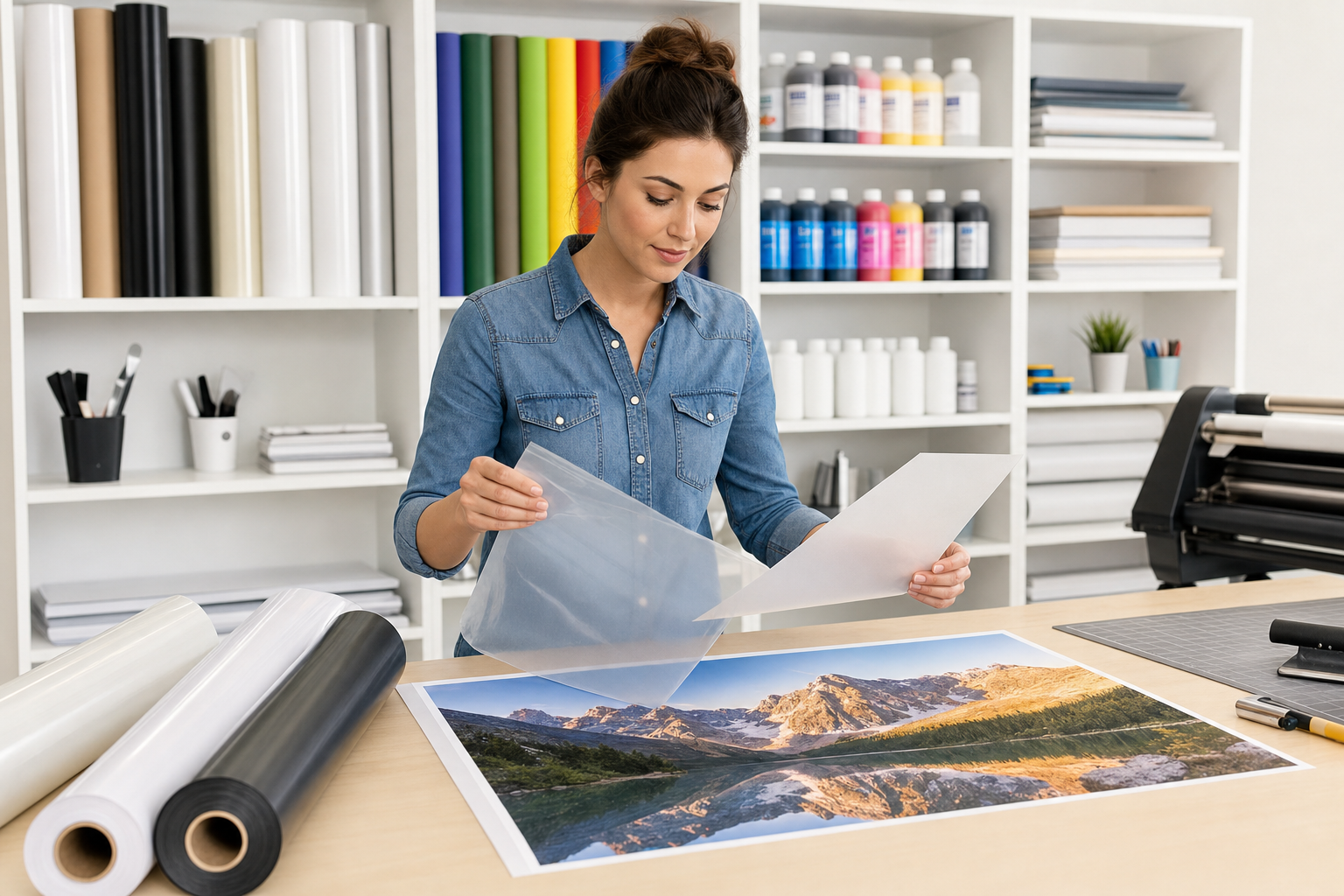
A good rule is to test before committing to a full run. Print a sample, let it cure according to the ink and media guidelines, then laminate and inspect the result after 24 to 48 hours.
Think about outdoor exposure and durability
For outdoor graphics, lamination is often about much more than looks. UV exposure, rain, temperature swings, and physical contact all affect the life of the print.
When specifying outdoor lamination, consider:
- UV protection, especially for colour stability
- Thickness, thicker films often improve abrasion resistance
- Edge sealing, to reduce moisture ingress and lifting
- Conformability, if the graphic will wrap curves or textured surfaces
Short-term outdoor signs may only need basic protection. Long-term vehicle graphics, pavement decals, or exposed panels usually need more durable overlamination and careful edge management.
Cost control without compromising quality
Lamination adds cost, so it should be justified by the application. The cheapest film is not always the most economical choice, especially if it leads to reprints or short service life.
Ways to control cost:
- Use premium finishes only where the client will notice the benefit
- Reserve heavy-duty films for high-wear or outdoor jobs
- Standardise a small range of trusted films for core applications
- Test compatibility before buying in bulk
- Balance thickness and performance, not just price per roll
It is often more cost-effective to specify the correct film first than to replace a failed graphic later.
Common mistakes to avoid
A few preventable errors cause many lamination problems:
- Laminating too soon after printing
- Using a film not intended for the substrate
- Ignoring surface contamination like dust or fingerprints
- Choosing gloss for a glare-prone environment
- Applying heat to media that cannot tolerate it
- Skipping test pieces before a full production run
Even experienced print shops benefit from a simple process check. Clean surfaces, correct nip pressure, verified curing time, and a sample test can prevent waste.
Practical conclusion
The best lamination is the one that matches the print’s purpose, environment, and handling demands. Start by deciding whether the priority is protection, appearance, or both, then choose a finish and application method that fits the substrate and print technology.
As a practical rule, use gloss for impact, matte for readability, satin for balance, and soft-touch for premium presentation. Choose cold lamination for most modern print and signage jobs, and only use heat where the media and workflow are clearly compatible. When in doubt, test a sample, check curing and adhesion, and confirm the job requirements before placing a full order.
A well-chosen lamination can extend the life of a print, improve customer satisfaction, and reduce costly rework. That makes it one of the most valuable finishing decisions in the shop.
A practical specification guide within Chemtech Group. Explore the wider Chemtech Group ecosystem.